Your First 0.001 BTC Arrives in Days, Not Months
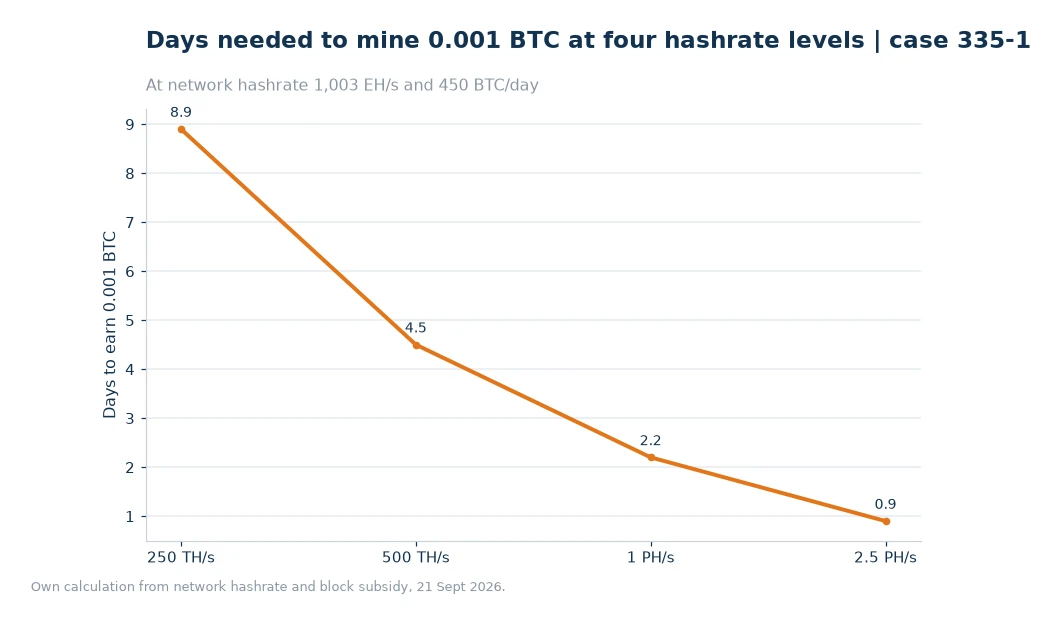
Most mining writing aims at people with racks. A single machine still has a milestone worth watching, and it arrives faster than expected: 0.001 BTC takes about 8.9 days at 250 TH/s on the 21 Sept 2026 figures, 4.5 days at 500 TH/s and 2.2 days at 1 PH/s. At $84,692 per BTC that milestone is worth $84.69 — small, but real, and measurable.
Key takeaways
- 0.001 BTC at 250 TH/s takes about 8.9 days, which is roughly 214 hourly credits under PPS+.
- Doubling hashrate halves the wait: 500 TH/s is 4.5 days, 1 PH/s is 2.2 days, 2.5 PH/s is 0.9 days.
- The milestone is worth $84.69 at $84,692 per BTC, which is a useful scale for judging fees and power.
- A target this small turns a single machine into a test instrument: a missed day is visible immediately.
A small target is a good instrument
Large targets hide faults. If the plan is to reach one bitcoin, a machine running 7% slow for a fortnight disappears into the noise of a long project. A target that lands inside two weeks does the opposite: the expected arrival date is close enough that a delay is noticeable while the cause is still fresh, and short enough that a reboot, a cable or a firmware change can be traced to a specific day.
That is the argument for picking a milestone you can hold in your head. It is not about the money, which is modest. It is about having a checkpoint that converts a vague sense that the rig is fine into a comparison between two numbers you wrote down.
It also gives a newcomer a reason to learn the interface properly. Reading a cumulative total, a hashrate line and a payout history is a small skill, and it is the same skill a larger operation uses every morning. Starting with a target that resolves in nine days means the learning happens while the amounts are still small.
What 0.001 BTC is worth, and what it is not
At $84,692, 0.001 BTC is $84.69. That is less than most power supplies and more than a month of electricity for a single efficient machine at a modest tariff. It is also the amount that makes the fee structure legible: 4% of $84.69 is $3.39, a figure small enough to ignore and large enough to be worth understanding when you multiply it across a year.
What it is not is a return on hardware. Anyone buying a machine to earn $84.69 has bought an expensive lesson in arithmetic. The milestone is a diagnostic, and the value of a diagnostic is the problems it catches early, not the coins it contains.
There is a second use for the figure: it makes power cost visible. A single efficient machine drawing roughly 3 kW for 214 hours consumes around 640 kWh, so at $0.06 per kWh that is $38.40 of power against $84.69 of coin — the margin is there, but it is a margin, not a windfall. Change the tariff to $0.12 and the same 214 hours consume $76.80, which is most of the milestone. The arithmetic does not tell you what tariff you pay, but it shows how much the answer matters.
Four sizes at a glance
The table switches units because at this scale days are a blunt instrument. Hours make the difference between a machine that reaches the target within a working day and one that takes a week and a half.
| Hashrate | BTC per day | Hours to 0.001 BTC | Days |
|---|---|---|---|
| 250 TH/s | 0.00011215 | 214.0 | 8.9 |
| 500 TH/s | 0.00022430 | 107.0 | 4.5 |
| 1 PH/s | 0.00044860 | 53.5 | 2.2 |
| 2.5 PH/s | 0.00112150 | 21.4 | 0.9 |
Worked example
Take the 250 TH/s case and carry it down to a single hour, because the hourly credit is what the account actually shows.
- Daily output per terahash is 450 ÷ 1,003,000,000 = 0.0000004486 BTC.
- 250 TH/s gives 250 × 0.0000004486 = 0.00011215 BTC a day.
- 0.001 ÷ 0.00011215 = 8.917 days.
- In hours: 8.917 × 24 = 214.0.
- Per hour: 0.00011215 ÷ 24 = 0.000004673 BTC, so the milestone is 214 credits of that size.
- At $84,692, 0.001 BTC is $84.69, and one hourly credit is about $0.40.
- The 2.5 PH/s machine is ten times larger, so its 21.4 hours is the same 214 credits compressed into a single day.
A daily habit that catches failures early
Check the running total at the same time each day and write it down. With an 8.9-day target, a day without a credit is a fifth of the milestone missing, which is impossible to overlook. With a six-month target, the same day is a rounding error and the fault runs for another three weeks.
The habit costs about a minute. It also builds the record that makes a later question answerable: was the machine always at this rate, or did something change after the move, the firmware update or the heatwave? Without the record, every explanation sounds equally plausible.
Two columns are enough at the start: the date and the cumulative coin total. A third column for the pool's reported hashrate is worth adding once you have a fortnight of rows, because it separates a quiet day for the pool from a quiet day for the machine. After a month the sheet becomes a baseline, and every later change gets compared with it.
Pool Luck looks different at this scale
At 250 TH/s, a PPLNS payout depends on the pool's finds across the last five difficulty rounds, and a quiet window can leave the account short of the expected path even when nothing is wrong. Pool Luck is the name for that gap, and at a small hashrate it can be a large share of a single milestone. PPS+ avoids it on the block-reward component by settling hourly against difficulty.
The practical difference is in what you can conclude. A flat hourly series that misses its expected total by two credits is a machine problem. A lumpy series that misses by two credits is probably timing, and the next window may return above the line.
That is the main reason a first milestone is easier to read under PPS+. The series is flat, the expected value is a division, and a deviation points at the machine rather than at the pool's luck. If you do choose PPLNS, extend the milestone to a month or more before drawing conclusions, and compare the ViaBTC Pool Hashrate trend with your own to see whether the pool or the rig moved.
Frequently asked questions
How long does 0.001 BTC take on one small machine?
At 250 TH/s it takes about 8.9 days, or 214 hourly credits, assuming the network total stays near 1,003 EH/s and the machine runs continuously.
Is 0.001 BTC enough to withdraw?
The amount is small — $84.69 at $84,692 per BTC — so check the current payout minimums in the wallet before planning a withdrawal around it.
Why did my milestone arrive a day late?
Under PPS+ the hourly credit follows difficulty, so a late arrival usually means lost uptime or a lower effective hashrate rather than a change in the pool's rate.
Set the next milestone before this one lands
Pick the next checkpoint while the first is still in progress: 0.005 BTC, or 0.01, or simply a month of daily rows with no gaps. A milestone that follows the first one keeps the habit alive after the novelty fades, and the habit is the part that actually protects the hardware.
Keep the credited coins and the payout history in the multi-currency wallet so the milestone can be verified against a statement rather than a screenshot, and read the listed fee rates once so the $3.39 deduction on $84.69 is expected rather than surprising.
Sources: ViaBTC wallet, pricing and pool state pages; network figures read 21 Sept 2026 — hashrate about 1,003 EH/s, difficulty 132.76 T, 3.125 BTC per block, 144 blocks a day, BTC $84,692. Published 24 Oct 2026. Times assume constant difficulty and full uptime[1].