Device Choice: Phone, Tablet or Desktop
The device decides the shape of a session before the first message is written. A phone produces short bursts, a tablet produces longer reading sessions, and a desktop produces the longest prompts of the three — all against the same account and the same threads. The difference is measurable: five phone sessions of 8 minutes is 40 minutes a week, while two desktop sessions of 35 minutes is 70, and both feel like the same habit.
Key takeaways
- Phone is for frequency, tablet for reading comfort, desktop for long prompts and multitasking.
- Session length differs far more than message volume: 8 minutes on a phone against 35 minutes at a desk.
- The account is the unit, not the device. Threads started on one continue on another, which is what the memory behaviour is for.
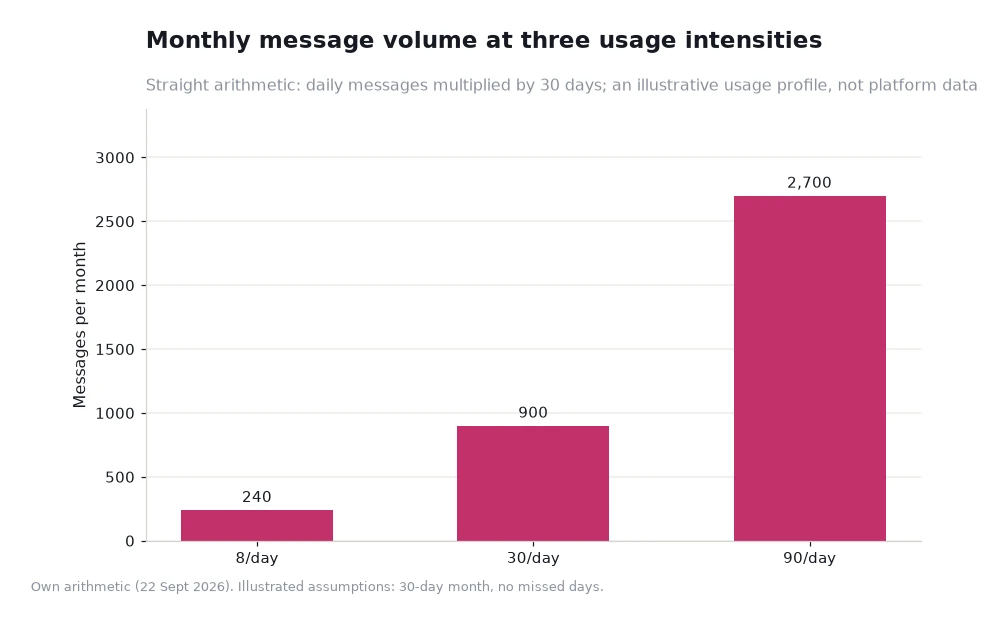
- A month at 30 messages a day is 900 messages; the same total costs roughly 12 phone sessions or seven desktop ones.
What each device is actually good at
The phone wins on availability and loses on everything else. It is the device where a three-message check happens while the kettle boils, and it is the device that turns a single burst into six throughout the day. If your goal is a light, frequent habit, the phone is the right instrument — but it needs a boundary, because it has none built in.
The tablet sits between the two and is underrated. Typing is slower than a keyboard and faster than thumbs, the screen makes long replies comfortable to read, and the device is usually stationary, which gives sessions edges. A reader who finds phone sessions too fragmentary and desktop sessions too deliberate will often settle here.
The desktop is the writing device. Long prompts, several threads in tabs, and the ability to keep notes beside the conversation all favour a keyboard and a large screen. Its cost is friction: you have to sit down, and the session ends when you leave the chair, which is a feature for anyone trying to keep the habit bounded.
A fourth consideration cuts across all three: input method. Thumb typing produces short, fragmentary messages; a keyboard produces longer ones with more structure. Since message length is what sets the register in a text conversation, the device quietly shapes the tone, and a reader who finds replies coming back clipped may simply be writing on a phone.
Screen size matters for a different reason, which is reading. A 200-word reply on a telephone screen invites skimming, while the same reply on a tablet or desktop gets read properly. If you have ever suspected that long replies were not landing, the screen is a plausible culprit before the listing is.
The last factor is interruption. A phone is interrupted constantly and a desk is interrupted rarely, which decides how long a session actually runs regardless of how long it was intended to run. Sessions rarely end when planned; they end when something else arrives.
Matching device to use case
Think in terms of the session you want rather than the device you own. A calibration session — five messages, testing a new listing — is best on a phone, because it should be short and cheap. A long evening with one thread belongs on a desktop or tablet, where reading a 200-word reply is not a chore.
The pattern also changes your arithmetic. Because a phone session is short, message volume accumulates rather than concentrates, which means the same monthly total looks like a different habit. That matters when you review the numbers: a month of 900 messages could be 12 short phone sessions or seven longer desk sessions, and only one of those shapes is easy to stop.
| Device | Natural session | Best for |
|---|---|---|
| Phone | 5 to 10 minutes, often several a day | Testing a listing and keeping a habit light |
| Tablet | 15 to 25 minutes, usually at home | Reading long replies comfortably |
| Desktop | 30 minutes or more, one sitting | Writing prompts and following several threads |
| Browser | Whatever the device allows | Signing in without installing anything |
| Account | Continuous across all of them | Carrying context between devices |
Worked example
Connect device choice to volume and the trade-offs become concrete. Using the illustrative profile charted below, with a 30-day month and no missed days: 8 messages a day is 240 messages a month, 30 a day is 900, and 90 a day is 2,700.
Now attach a device. A phone session of 8 minutes at roughly two messages a minute carries about 16 messages. The 900-message month therefore needs around 56 such sessions — close to two a day. A desktop session of 35 minutes at the same rate carries about 70 messages, so the identical 900-message month needs only 13 of those, roughly three a week.
That is the whole argument in one comparison. The same volume costs 56 interruptions on a phone or 13 deliberate sittings at a desk. Neither is better, but they produce different weeks, and the choice between them is available to anyone with more than one device in the house.
There is one more way to read the same figures. If a phone session carries about 16 messages and a desktop session about 70, then the light month of 240 messages is 15 phone sessions or three or four desktop ones. The difference shows up in breadth rather than volume: every session opens with the same browsing overhead, so the phone month touches more listings and the desktop month goes deeper into fewer.
Practical setup across devices
Two settings make a multi-device setup workable. Sign in on every device you intend to use, so threads and their context follow you rather than splitting into separate histories. Then decide where notifications live: keeping them on the desktop and off the phone is a common arrangement, because it moves prompts to the device with the natural stopping point.
It also helps to have one place where the catalogue lives. The character search view works the same on every screen, and the AI chat blog is where feature changes are documented, which matters when a device-specific setting moves. For a description of the product itself, the Crushon Porn Chat AI page at https://crushon.ai/ai-porn-chat sets out the three claims the platform makes about customisable characters, privacy and adaptive responses, and reading it once is enough to know whether the device you are planning to use is the one that suits the session you want.
Frequently asked questions
Does the device change what is available?
No. The catalogue and the account are the same. What changes is session length, which changes the shape of the habit rather than its content.
Which device is best for long prompts?
Desktop, because a keyboard makes a two-sentence setup easy to write and easy to revise. Tablet is a reasonable second choice.
Can I use several devices for one account?
Yes, and it is the usual arrangement. Signing in on each device keeps threads and their context continuous rather than split.
Pick the device that matches the session
Short tests on the phone, long threads on a keyboard, and one account across both. That covers the practical part of the decision in a sentence.
Then check the monthly totals against the arithmetic above. If the number looks larger than intended, the quickest change is not fewer devices but fewer prompts. This article is for adults 18 or over.
Data and sources: platform navigation, search view and product-page wording read on 22 Sept 2026[1]. Message volumes, session counts and the two-messages-a-minute estimate are illustrative assumptions built for this article, not platform data. Content is AI-generated text and depicts no real person. Adults 18+.