A Closer Look at Sourcing wire mesh fabric from China
Wire mesh can look similar while differing in alloy, wire diameter, opening size, weave, coating, and usable roll dimensions. Those differences change filtration, reinforcement, guarding, airflow, corrosion performance, and installation fit. Buyers should define a controlled specification and compare samples and production lots against the same measurable criteria before approving a supplier.
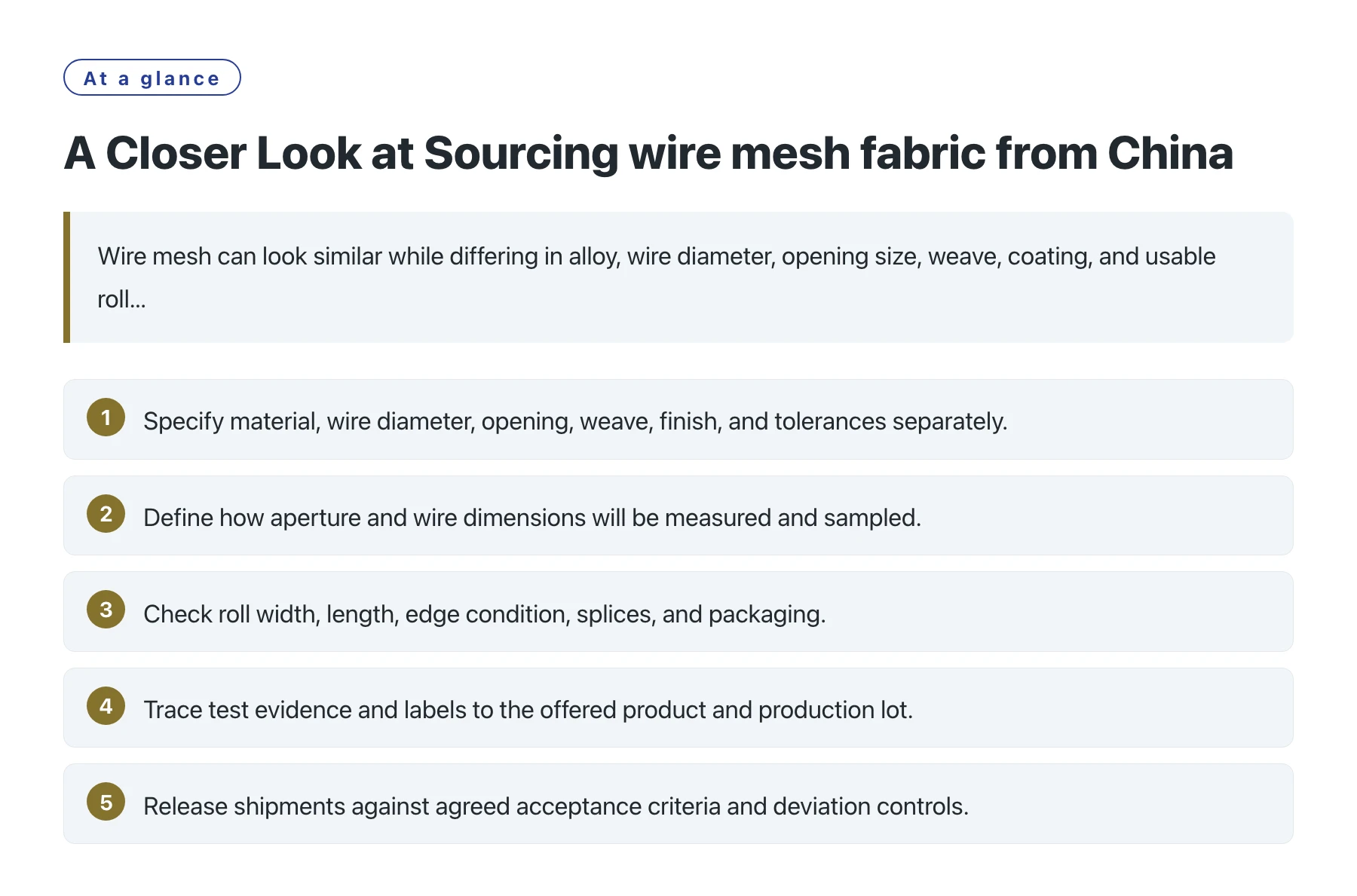
Key takeaways
- Specify material, wire diameter, opening, weave, finish, and tolerances separately.
- Define how aperture and wire dimensions will be measured and sampled.
- Check roll width, length, edge condition, splices, and packaging.
- Trace test evidence and labels to the offered product and production lot.
- Release shipments against agreed acceptance criteria and deviation controls.
A reliable wire cloth comparison starts with the application and turns each performance expectation into a verifiable drawing, schedule, or inspection record.
1. Describe the application before choosing a mesh
State what the mesh must do: screen particles, support a load, protect an opening, separate materials, provide ventilation, or form part of an assembly. Define the operating environment, exposure, cleaning, temperature, chemical contact, expected service life, and installation method. These conditions drive material and opening choices.
Record the consequence of an undersized opening, broken wire, corrosion, or dimensional mismatch. Construction and industrial uses can have safety or system implications, so the responsible engineer should set design limits and identify any applicable local requirements. Do not select solely by a photograph or a supplier’s generic “heavy duty” description.
2. Write a complete mesh schedule
List alloy or material grade, wire diameter, nominal aperture, weave type, mesh count where relevant, surface treatment, width, roll length, and edge form. Define units, tolerances, and whether dimensions refer to nominal or measured values. Identify the drawing revision and approved product code on every quote and sample record.
State which variables are independent acceptance criteria. Mesh count alone does not define the opening unless wire diameter and measurement convention are also known. If a coating is required, state whether dimensions and mass are specified before or after coating and how coating coverage will be assessed.
3. Confirm material and corrosion assumptions
Ask for the precise material designation and supporting documentation tied to the batch, rather than relying on broad terms such as stainless, galvanized, or corrosion resistant. Clarify substrate, coating type, coating mass or thickness where specified, and any passivation or finishing process. Compare against the actual service environment.
A material certificate can support identity but does not automatically demonstrate service life in every environment. For exposure to salts, moisture, chemicals, or outdoor weather, have the design owner confirm the appropriate material and test basis. Treat substitutions as formal changes requiring review and written approval.
4. Compare aperture and wire dimensions consistently
Agree on a measurement method, locations, instrument, sample count, and acceptance limits. Measure wire diameter across representative points and directions where the method requires it. Assess openings across the sheet or roll because variation, distortion, and weave irregularities can affect fit and functional performance.
ISO 9044 describes technical requirements and testing considerations for industrial woven wire cloth. Use the relevant standard and contract specification together; confirm the edition, product scope, and agreed tolerances with the technical owner. A standard reference does not replace a clear purchase specification. [1]
5. Inspect weave, finish, edges, and roll condition
Check weave pattern, wire continuity, broken or loose wires, local distortion, burrs, corrosion, contamination, coating defects, and edge finish against agreed criteria. Define whether selvage, cut edges, reinforced edges, or welded borders are required. Photograph representative defects with a scale and record their location.
For roll goods, verify actual usable width and length, winding direction, core, splice count, identification, and protection from moisture or impact. A nominal dimension may not equal usable material after damaged edges or splices are excluded; specify how that is counted and reported.
6. Check sample representativeness and production control
Identify the sample as prototype, production-intent, or ordinary stock. Record maker, site, process, material source, lot, date, and revision. Ask whether weaving, heat treatment, cutting, welding, and coating will take place at the same locations for the production order.
Request the supplier’s inspection plan for incoming wire, setup approval, in-process checks, final measurement, and lot identification. Determine how tooling or loom changes are controlled. If production is subcontracted, identify the responsible process owner and how finished lots remain traceable through shipment.
7. Agree on a practical inspection and release plan
Specify the lot definition, sampling approach, acceptance criteria, instruments, reporting format, and timing before ordering. A shipment check can confirm selected dimensions and visible condition, but it cannot prove every performance property or long-term durability. Arrange laboratory testing when the risk and specification require it.
Define what happens after a failure: hold the lot, segregate affected material, investigate cause, propose rework or replacement, and reinspect. Name who can approve a concession. Shipment release should depend on closure of critical findings and the required records, not only on a booking deadline.
8. Compare landed and usable cost
Compare quotes using the same grade, tolerances, usable dimensions, packaging, order quantity, inspection scope, delivery rule, and named destination. Clarify scrap allowance, minimum order, roll-length tolerance, packaging charges, tooling, and how price changes apply when material inputs change.
A lower price may reflect lighter wire, wider tolerances, shorter usable rolls, or a different coating. Model cost per usable area or accepted unit when that matches the application. Keep freight, duties, destination costs, and expected waste visible as separate assumptions.
9. Freeze the approved configuration and monitor change
The purchase order should identify approved drawing, material, weave, dimensions, finish, packaging, lot records, inspection plan, and approved manufacturing site. Keep the signed sample, measurement report, and deviation log together. Communicate acceptance criteria to the supplier before production starts.
Review any changes to wire source, alloy, diameter, weave setup, coating, subcontractor, site, package, or process. Buyers seeking wholesale construction materials from China can use a consistent specification and inspection workflow to compare supplier proposals and keep evidence attached to each revision.
Sources
Frequently asked questions
Is mesh count enough to specify woven wire fabric?
No. Define material, wire diameter, aperture, weave, finish, dimensions, and tolerances for the application.
Should buyers inspect every roll?
Set sampling and measurement rules based on lot size, risk, contract terms, and the consequence of a defect.
Does a material certificate prove corrosion performance?
No. It supports material identity; service suitability depends on environment, design, finish, and validation.
What should happen if a shipment fails inspection?
Hold affected goods, document the finding, agree corrective action, and reinspect before authorized release.